I have a confession to make. When I started using AI to write my copy, it stopped sounding like me.
A client told me the same thing that very morning. They'd been using AI to write their website copy, their emails, their social posts. And they said, "It doesn't feel authentic. It doesn't feel like us."
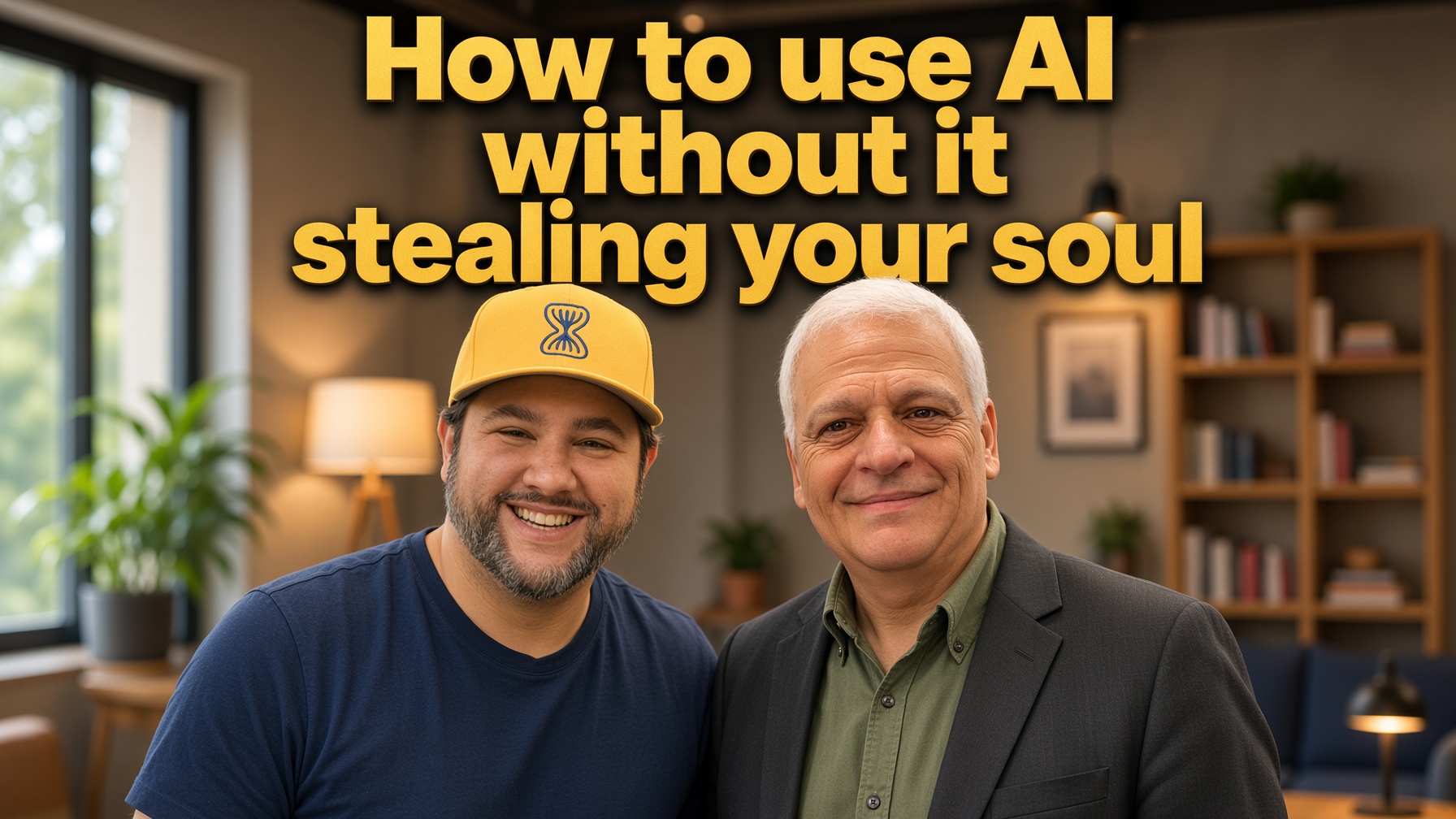
I knew exactly what they meant. So on Episode 14 of Renegade Breakthroughs, I sat down with Joe Casabona, founder of Streamlined Solopreneur, to talk about something I think a lot of business owners are quietly struggling with. Joe calls it AI brain rot. And once you hear the four warning signs, you might recognize a few of them in yourself. I sure did.
Who Is Joe Casabona?
Joe helps solo business owners save about 25 hours a month without leaning too hard on AI or hiring a big team. He's got a master's degree in software engineering, 18+ years as a teacher, a TEDx talk, and the How I Built It podcast. He's spoken at dozens of conferences and helped hundreds of solopreneurs get 10 to 15 hours a week back.
He's also a Yankee fan and a New Yorker who agrees with me that New York pizza is the best. So you know he's got good judgment.
Here's the thing that makes Joe's take on AI so valuable. He's not an AI hater. He's a software guy. In grad school he studied software that writes itself. Just days before our interview, he used Claude Code to move 20 years of content off WordPress and onto a brand new site, without breaking thousands of links. A job that would have taken him weeks, done in an afternoon.
So when a guy like that warns you about AI brain rot, you listen.
How I Taught AI to Write Like Me
Before we get to Joe's four signs, let me tell you what happened when I tried to fix my own problem.
I asked Grok how to make AI sound more like me. It went wild with over-the-top recommendations. Not helpful. So I asked Claude. Claude said, "Simple. Feed me things you've written."
So I did. I gave it about 480,000 words of my own writing, going all the way back to 1999. Here's what it found:
My style hasn't changed in 27 years. It measured the difference between my 1999 copy and my 2026 copy. Practically zero. (I'm choosing to take that as consistency, not a lack of growth.)
I never use em dashes. Claude assumed I used them occasionally. After 480,000 words? Not one. That's one of the biggest tells that AI wrote something, so now my style sheet bans them.
It caught the one piece I didn't write. One document in that folder was AI-generated. Claude flagged it immediately.
I have three distinct voices. One for books, one for sales letters, one for emails. It built a style sheet for each.
Then I tested it. I sent an email written entirely by AI, untouched. My friend Bruce Poppy called me the next morning and said, "Great email. Sounded exactly like you."
So yes, you can train AI to sound like you. But here's where Joe stopped me in my tracks.
"Saying AI Wrote Your Book Is Like Saying You Ran a Marathon With Your Car"
Joe told me that even if AI sounds exactly like me, it will never know the things I've never written. It won't have my lived experiences. It won't know what happens to me tomorrow.
"That's the stuff that makes us human," he said. "That gives us our soul."
His rule for avoiding AI brain rot is simple. Use AI for task, not craft. Let the computer do computer things. Keep the craft, the human-to-human part, for yourself. Because that's where your soul lives.
And I love his analogy. Saying AI wrote your book is like saying you ran a marathon with your car. Technically you crossed the finish line. But did you really do it?
What Is AI Brain Rot?
Joe came up with the idea during a webinar. He opened the floor for Q&A, and someone got on and said, "I had to ask ChatGPT what question I should ask you."
They couldn't even come up with their own question.
That's AI brain rot. It's what happens when you hand your thinking over to a machine so often that you stop doing it yourself. And according to Joe, preventing it is exactly how you use AI without losing your soul.
The 4 Warning Signs of AI Brain Rot
1. You're a Reflexive User
You hit a problem, and before you spend even five minutes thinking about it, you're typing it into ChatGPT.
The fix: Go for a 20-minute walk. Think it through yourself first. Come up with your own solution. Then, if you want, throw it into AI and say "red team this." But your brain goes first.
2. You're a People Skipper
Instead of talking to your customers, you ask AI to describe them. "My ideal customer is Alex, a dad of three running his own business. What problems does he have?"
AI will give you a statistically likely answer. But it's not a real answer. Joe admitted this one got him. He didn't think his audience would answer his questions, so he let AI decide what his podcast should cover. And he says it hurt the show for a while.
The fix: Talk to actual human beings. Get into communities. Ask the people you serve what's keeping them up at night.
3. You Have No Skin in the Game
When you ask AI to "come up with a plan for me" without thinking about it first, you haven't invested anything. Joe compared it to playing poker for no money. There are no stakes, so you'll go all in on a 2-7 just to see what happens.
The fix: Write your own first draft of the plan. Think through your goals and your current problems. Build something you're actually committed to.
4. You Use AI as Your Adviser
This is the culmination of the first three, and Joe says it's the most dangerous. You're reflexively asking questions, skipping the people who could actually help you, and following a plan you have no stake in.
Not only is the advice generic, it can be flat-out wrong. Joe shared a story about a man who asked ChatGPT for a salt substitute and ended up ingesting something toxic. It's like asking AI if a mushroom is edible, eating it, and hearing, "You're right, that mushroom was poisonous. Sorry for the confusion."
What we're really losing here is critical thinking. And that's the scariest part of AI brain rot.
AI Looks at What Was. We Create What Will Be.
I told Joe about a conversation I had with my friend Mitch Axelrod, who was worried AI is going to replace all of us. I told Mitch, no way. We have real-world experience that AI doesn't have. AI looks at what was. It doesn't create what will be. That's us.
Joe put it perfectly. If you'd asked an AI in Galileo's day, it would have given you the accepted answer of the time, not the right one. Because it only knows what we've already created.
He also shared a study that should make every business owner stop and think. People rated AI as very accurate in areas where they weren't experts, and not very accurate in areas where they were experts.
Do you see the problem? If you don't know the subject, you can't tell good output from garbage. Joe calls AI a "word calculator." It gives you a statistically likely answer. That doesn't mean it's the correct one. And when it doesn't know, it makes something up and says it with total confidence.
That's why I always tell business owners: if you've never written a sales letter, how do you know if the one AI just wrote for you is any good? You don't. You buy traffic, you wait, and you find out the expensive way.
AI Brain Rot in Business: Is It Actually Working?
Joe asked a question every business owner using AI should be asking.
A friend of his has a team of AI agents writing his blog posts. He drops ideas in a bank, an agent picks one every morning, writes the draft, and publishes it. When Joe asked when he'd feel uncomfortable putting his name on it, the friend said, "Well, it's my idea."
Joe's response: "I had the idea for Facebook six months before Zuckerberg did. I don't have Zuckerberg money." Ideas aren't execution.
Another friend told Joe that Claude is great at writing sales copy. Joe asked, "Is it great because you don't have to do it, or because it's actually converting?"
That's the right question. I've been testing this myself. I put up a sales page written purely by Claude and one written by me. I beat Claude every time. It looks good. It's just not me. And people can feel the difference.
Energy Is the One Thing AI Can't Fake
When I wrote my book Motivational Marketing, I paid close attention to the energy of the writing. I wrote one chapter a week for 16 weeks, every Saturday. And I never wrote a line unless I was in the zone.
One Saturday, Phoebe called me at 5:00 and asked if I was done. I hadn't written a single word. I wasn't feeling it, so I didn't write.
When the book came out, people told me, "I can feel your energy in this." A machine can't recreate that.
Joe had a great example of his own. In one of his books he put a footnote on the word "wiggle" that just said "wiggle wiggle wiggle," a nod to the LMFAO song that was huge at the time. No normal writer would do that, and AI certainly wouldn't. But anyone who knows Joe reads it and says, "That's Joe."
That's your soul on the page. Protect it, because AI brain rot will quietly sand it away if you let it.
AI Is a Hammer. How Will You Use It?
When I first got on a computer in 1980, a TRS-80, everyone panicked that computers were coming for their jobs. Back then, our creativity was miles ahead of what the machines could do.
With AI, that's flipped. The tool is now way ahead of us in raw capability. So it's up to us to bring the creativity, the judgment, and the humanity.
AI is like a hammer, and AI brain rot comes from letting the hammer swing you. You can use a hammer to smash a jewelry case, or you can use it to build a house. The tool doesn't decide. You do.
How Joe Got His Time Back
In 2020, Joe had a panic attack. He was the classic solopreneur: "If I want it done right, I have to do it myself." His wife is a nurse and was working long hours during the pandemic. They had two little kids at home. His business ground to a halt.
That's when he realized he literally couldn't do it all. So he started automating, and he finally hired a virtual assistant.
Today he helps business owners do the same thing, using automation and AI the smart way, without the AI brain rot. Take things off your plate so you can spend time with the people you love. Or go see a movie on a Tuesday afternoon, when nobody's in the theater.
You can learn more and sign up for Joe's weekly newsletter at StreamlinedSolopreneur.com, and read his essays at Casabona.org. You'll also find him on LinkedIn and Bluesky.
The Bottom Line on AI Brain Rot
AI isn't going away. I've been selling online since 1989, and I've seen every "this changes everything" wave come and go. This one is real. But it has a catch nobody's talking about.
Use AI for tasks. Keep the craft for yourself. Think first, talk to real people, put some skin in the game, and never let a machine be your only adviser.
That's how you use AI without losing your soul. And that's how you beat AI brain rot before it starts.
Want a head start? Grab my free Renegade AI Survival Toolkit at renegade.club/toolkit. It's a quick 20-minute read that explains what AI is, how it works, and includes a glossary of terms so you're never lost in the conversation.