Today, a Senate committee voted 8-7, along party lines, to hold Dr. Anthony Fauci in contempt of Congress. Last week, he sat in front of that same committee and invoked the Fifth Amendment more than 100 times rather than answer questions about the pandemic response. Whatever side of that vote you land on, I'm not here to litigate guilt or innocence — that's for the Senate, and if it gets there, a jury. I'm here to talk about something bigger: why so many of us stopped being surprised when "the science" turns out to have a footnote nobody told us about.
Held in Contempt
Fauci's team says the whole hearing was a setup, designed to trap him into a perjury charge. Committee chair Rand Paul argues that Fauci's 2025 pardon from President Biden means he can't legitimately plead the Fifth in the first place, and he's pushing for a referral to the Justice Department. The matter now heads to the full Senate floor, where it has to clear a filibuster before the DOJ ever decides whether to prosecute. Nothing here is settled. But the moment is still worth sitting with, because it's not the first time. And if we don't learn the actual lesson underneath it, it won't be the last.
The Pattern
Here's the thing that gets lost in the noise of any single hearing: this isn't one bad moment. It's a pattern, and the honest version of it — the version that survives fact-checking — includes the other side's explanation every time.
Take the six-foot rule. For two years, "stand six feet apart" was treated as settled science, enforced with tape marks on gym floors and closed playgrounds. In June 2024 testimony, Fauci told Congress it "sort of just appeared" and wasn't based on data. He later clarified he meant there was no randomized trial comparing six feet to three or ten — the CDC says it leaned on 1955 droplet research instead. Even taking the more generous read, a rule the public was told was precise science turned out to be an educated guess.
Or masks. In March 2020, Fauci and the Surgeon General told Americans there was no reason to walk around in one. Weeks later, the guidance flipped to universal masking, and for a lot of people, staying masked became close to a moral test. Fauci later said the early guidance was shaped partly by a real shortage of protective equipment for healthcare workers, not purely by the science changing. That's a legitimate defense. It also means the public wasn't told the real reason for the guidance at the time it mattered most.
Or the vaccines. In 2021, the CDC director said vaccinated people "do not carry the virus, don't get sick." Fauci called them "dead ends" for transmission. President Biden said vaccinated people "do not spread the disease to anyone else." Within months, breakthrough transmission during the Delta wave showed that wasn't true.
Or gain-of-function funding. In May 2021, Fauci told the Senate flatly that the NIH "has not ever and does not now fund gain-of-function research" at the Wuhan Institute of Virology. The NIH's own former acting director later told Congress the agency had, in fact, funded gain-of-function-type research there.
Notice what all four have in common. Not one was presented as a best guess. Every one was delivered with total certainty — trust the science — right up until it wasn't true anymore.
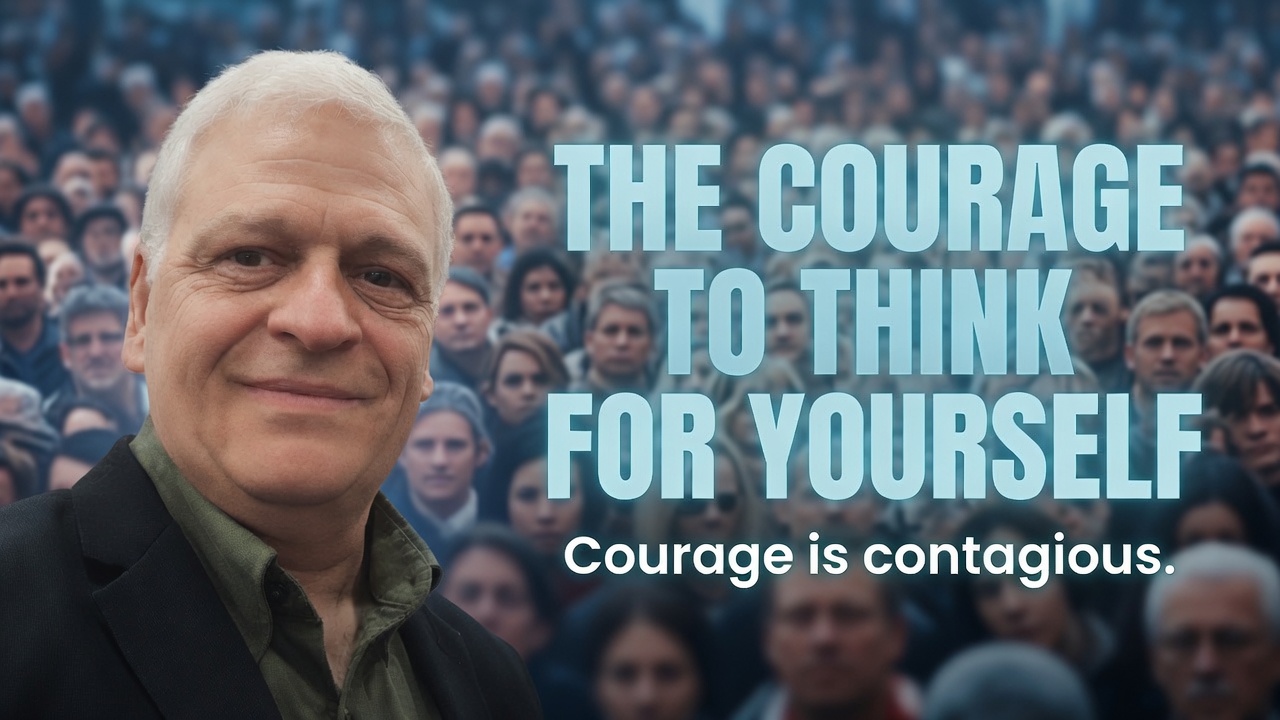
Building the Courage to Think for Yourself
So what do you actually do with that? Not "trust no one." That's not courage, that's just a different kind of laziness dressed up as skepticism.
Real courage is the willingness to ask anyway. You can respect expertise and still ask what the evidence is and what happens if the expert is wrong. And here's a filter worth adopting: certainty is a red flag, not a green light. Real science hedges, because it's supposed to. When someone in authority sounds one hundred percent sure about something that's still evolving in real time, that's worth a second look, not less scrutiny.
Ask who pays a price if they're wrong, too. The officials who deliver bad guidance rarely lose their job over it. You do — in time, money, or trust in the people you thought had your back. That asymmetry is exactly why you can't outsource the thinking. This isn't about being contrarian for its own sake. It's "verify before you comply," especially when compliance is going to cost you something real.
Why Blind Trust Costs You in Business, Too
Here's the flip side, for the builders and leaders reading this. Every industry has its own Fauci moment — the marketing guru who swore by a tactic that quietly stopped working two years ago, the "best practice" everyone copied because everyone else was already doing it. Confidence was never a track record.
Build your own filter before you need it. Don't wait for a crisis to start asking where the data behind a recommendation actually comes from — make it a habit on an ordinary Tuesday. Run small tests instead of taking a big trust fall. You don't have to bet the business on someone else's certainty; pilot it, check it against your own numbers, scale what actually works for you. And own your own calls, mistakes included. The flip side of not blindly trusting authority is that you don't get to blame it when your own bet doesn't pay off either. Courage cuts both ways.
They Don't Need Your Courage to Be Right
They don't need your courage to be right. They need your compliance to be easy. Don't confuse the two.
Today's vote is one data point in a much longer pattern. The lesson was never "trust nothing." It's "verify before you comply" — and build that muscle now, before the next crisis makes it expensive not to.
Listen to the full episode, "The Courage to Think for Yourself" — and tell me in the comments: what's one thing you were told with total confidence, by an official, an expert, or a guru, that you later found out wasn't true?